Every advertiser has a theory about the calls. The rep who rings up pushing a bigger budget, broad match, and Performance Max, and you wonder if there is a script behind it that reads: get them to spend more. So the question deserves a straight answer, and a careful one, because it is a claim about what happens inside Google.
The straight part: the evidence points hard toward spend. The careful part: the exact word trained is one we cannot prove, and this article will show you why, then show you what the record does support. The gap between those two things is the whole story.
The honest limit first
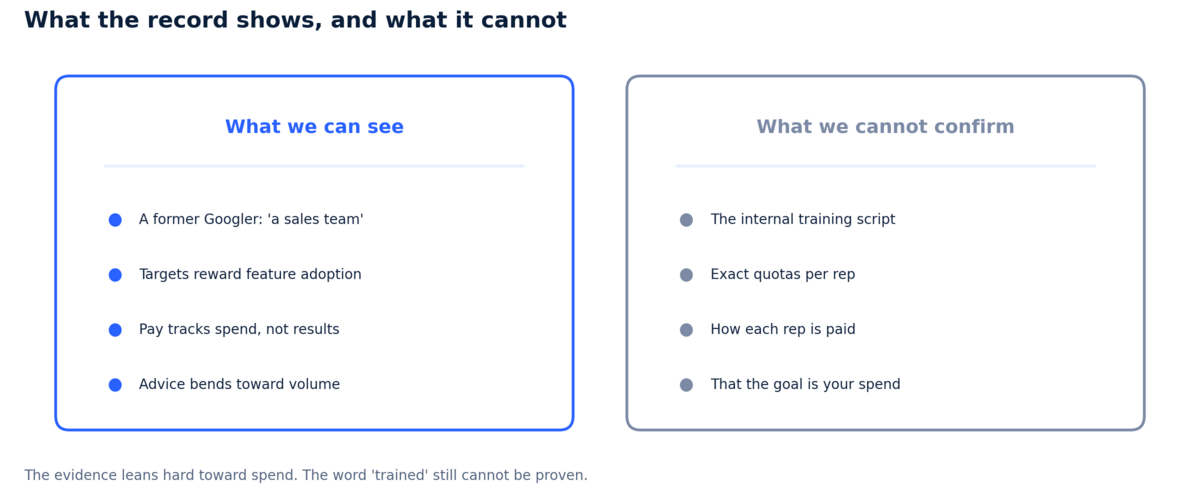
Start where an honest answer has to start. Google does not publish how it trains its reps, what quotas they carry, or how they are paid. That information sits inside the company and inside the vendors it uses.
So anyone who tells you, as a flat fact, that Google trains reps with the goal of raising your spend is claiming to know a script they have not seen. We will not do that. What we can do is weigh what is on the record: a former insider, the targets reps are measured on, and the advice they give. All three lean the same way, and together they are strong. They are just not the same as a leaked training manual, and we will keep that line clear.
What a former Googler says
The most useful account comes from inside. Jyll Saskin Gales worked at Google for six years, and now teaches Google Ads. She describes the rep teams in clear terms: they are sales teams, and, in her words, there are things reps must pitch. That is close to the heart of the question, from someone who sat in the building.
She also describes a team called the Accelerated Growth Team. The way it works, she explains, is that you make a commitment to spend a set amount over three to six months, and in return you get a higher level of service. The name says the rest: accelerated growth, which she sums up as “more money.” To her credit, she adds the fair caveat, that reps should still focus on your goals, and that the more you share, the more they can help. So the insider view is not “reps are villains.” It is “reps are sales, and spend is the point.”
The targets we can see
Below the Google employees sit the outside vendors, and here the targets come into view through former reps and the agencies who deal with them.
By these accounts, reps are measured on things like feature adoption, getting you onto Performance Max, broad match, and automated bidding, plus a count of “optimization actions” per account and a quota of calls. Their pay, agencies report, tracks what you do after the call, not whether your results improved. One write-up lists the same recurring targets for adoption and “optimization actions”, and notes that reps are measured on your actions, not your outcomes. None of these is a Google document, so hold them as consistent, well-reported experience. But notice the shape: every target listed is a thing that tends to raise spend, and none is your profit.
The advice all points one way
You do not need the training script when the advice is this consistent. Look at what reps push, again and again.
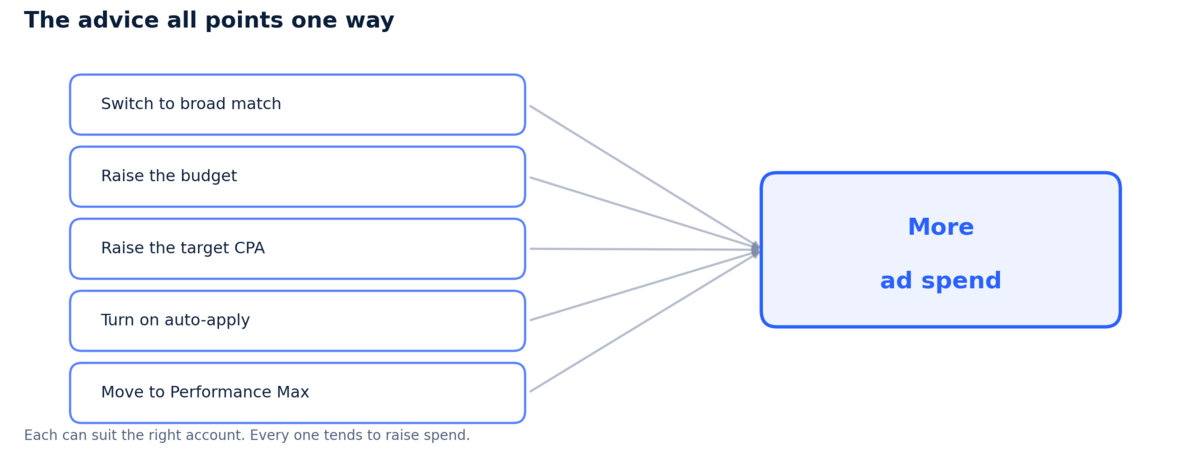
Switch everything to broad match. Raise the budget. Raise your target cost per acquisition. Turn on auto-apply. Move to Performance Max. Each can suit the right account, and each tends to widen reach or lift spend. One PPC expert, Brad Geddes, reviewed 50 budget recommendations and reported that every one would have cut return on ad spend or doubled cost per acquisition, which comes from an agency write-up, not Google, so weigh it as expert experience. Even Google’s own help pages nod at the direction: set a more efficient target, Google notes, and “your daily spend will likely be impacted.” The tools bend toward volume. That is not a secret, and it does not need a manual to explain.
|
A sales team, by their own account A former Google employee says these are sales teams with things they must pitch. We cannot see the training script, but the targets and the advice both point one way: more spend. |
Where the picture is mixed
Now the honest turn, because a one-sided answer would be its own kind of lie.
Not every rep is a robot, and not every recommendation is bad. New advertisers can get real help from a rep who sets things up right. Plenty of recommendations, such as fixing broken conversion tracking or adding negative keywords, cost nothing and help you. And the data is not one-sided: a study by the tool Optmyzr found that accounts with higher optimization scores showed better cost per acquisition and return on ad spend on average, which suggests the recommendations are not junk. Correlation is not proof, and that is one tool’s sample. The fair read is not “reps lie.” It is that reps sell inside a system that earns when you spend, so their advice is a pitch shaped by that fact. Some of it is good for you anyway. Your job is to tell which.
How to protect yourself
So keep the call, and keep control. A few habits settle the whole question in your favor.
Judge every idea against the number you live on, which is profit, not the optimization score and not the rep’s target. Never let anyone change your account on a call. Ask for the suggestion in writing, then test it with an experiment so you compare real outcomes. Keep a written strategy, because it is easier to say no when you know your plan. And know the limit of a rep in full: they handle sales and setup, not enforcement. If you have a Google Ads account suspended, a spend pitch is useless, because a different team decides suspensions, and the way back is a policy fix and a clean appeal, not a bigger budget.
Who is telling you this
We recover suspended Google Ads accounts, so weigh the source. The easy sell would be to state as fact that every rep is trained to drain your wallet. We will not, because we cannot prove the training and we would rather give you the truth than the outrage. What the record supports is enough on its own: reps are a sales function, their targets reward spend, and their advice bends toward volume, so treat it as a pitch and check it against your profit. If your problem is a suspension, no rep of any kind can help, and that is our work. Our Google Ads free assessment will tell you what we find, including when a case cannot be won, which we turn down rather than bill you to lose.